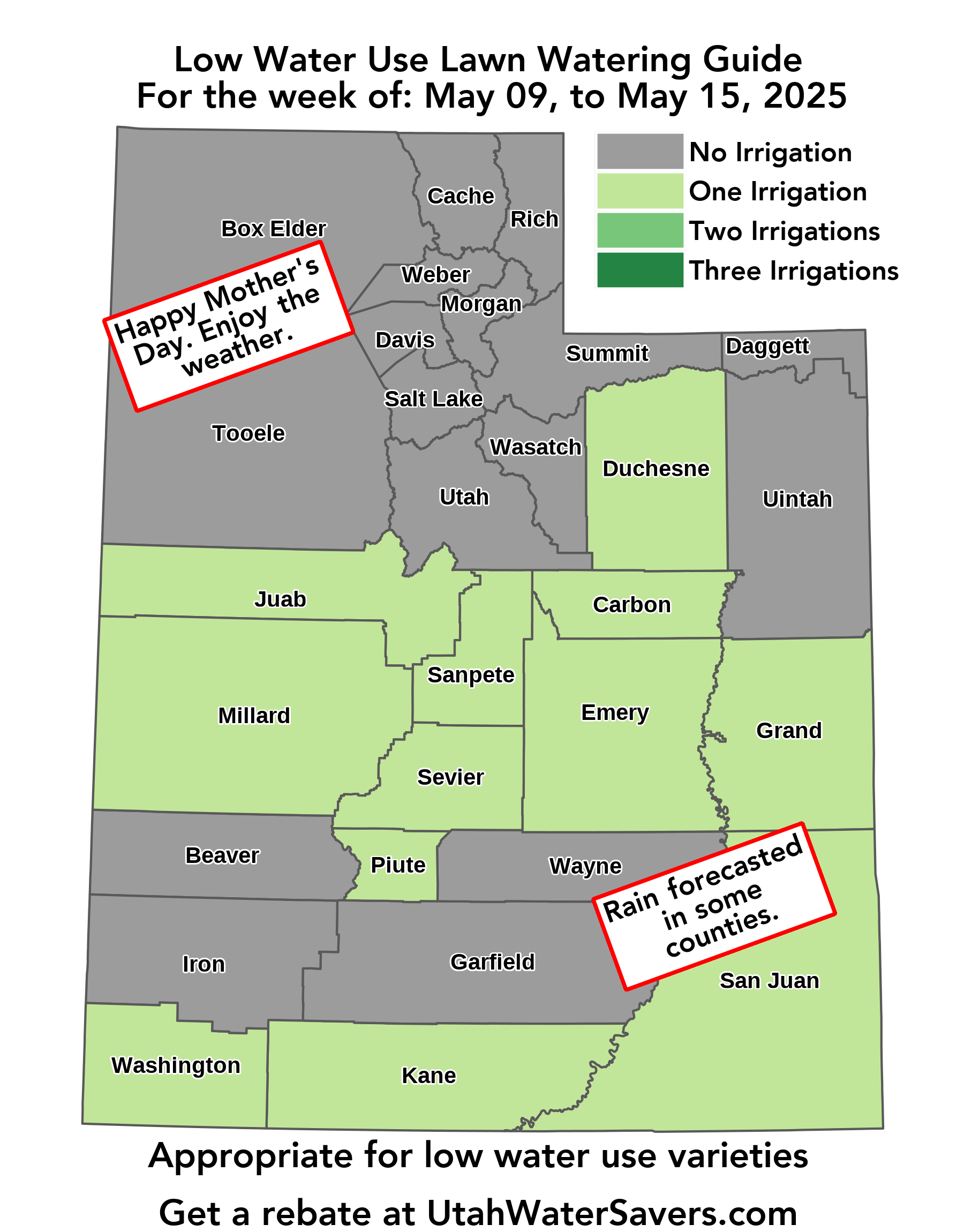
The Utah Division of Water Resources Weekly Lawn Watering Guides offer customized watering recommendations for your area and lawn type! These guides are created using weather data collected throughout the state, so the recommendations will vary weekly depending on what Mother Nature has in store. More and more Utahns are choosing to landscape with low water use lawn varieties (thank you!), so we’ve created an additional Low Water Use Guide. Be sure to select the appropriate guide below based on your lawn type. Conventional lawns should use the standard watering guide. Those that have intentionally planted low water use varieties should use the Low Water Use Lawn Watering Guide.
Weekly Lawn Watering Guide
Lawn can sustain large amounts of overwatering before negative consequences like diseases, weeds and insect pests start to become apparent. Because of this, it’s typically overwatered. One way to conserve water and maintain plant health is to avoid overwatering.
This guide assumes you are applying 1/2″ of water with each irrigation event. The chart on this page gives you an idea of how long you may need to run your system to apply 1/2″. Every system is a little different. For an accurate run time recommendation, participate in the free Water Check program.
Low Water Use Lawn Watering Guide
How long should I water?
The chart below shows how different sprinkler heads apply water at different rates. A higher precipitation rate means a shorter run time. For example, 1.3 inches per hour = 23 minutes.
Head type | Precipitation rate | Run time for 0.5" of water | Cycle recommendation |
Spray | 1.3" - 2.0" | 23 -15 min | 3 cycles |
Rotor | 0.4" - 1.0" | 75 - 30 min | 3 cycles |
Multi-stream, multi-trajectory | 0.4" - 0.6" | 75 - 50 min | 3 cycles |
*Information courtesy of the Center for Water Efficient Landscaping, Utah State University.
Not sure what your precipitation rate is? Schedule or DIY a water check.
Cycling Recommendation: Instead of running sprinklers all at once, split the total run time into three shorter cycles with 30–45 minute breaks in between. This ‘cycle and soak’ method helps the soil absorb water and reduces runoff.
Did you know that weather-based irrigation controllers use weather stations to determine how frequently your irrigation system should turn on? When programmed correctly, these controllers have the potential to save a lot of water. Find out if you qualify for irrigation controller rebates or other rebates and incentives at UtahWaterSavers.com.
Did you know? Outdoor water is often secondary water, which is different from drinking water. Secondary water is only safe to use for watering yards. Drinking or playing in it can make you sick. Learn more at SecondaryWaterSafety.utah.gov.